Thursday, October 23, 2025

Mining the Sacred: Eco-Grief, Colonialism, and the Kamoro’s Resistance

Photo by Niamh Keating

Reflecting on my time in West Papua and the readings for this week, I find that my experiences living and working with Freeport McMoran — teaching at the company’s expat school in Kuala Kencana from 2015-2016 — offer a lens through which to understand the ecological grief and displacement discussed by Aph Ko and Joanna Macy. These readings resonated deeply with my lived experience outside of Timika and the nearby villages of the Kamoro people.

At the time, I lived in a guarded compound, where the daily realities of safety protocols — armored buses and armed guards — underscored the conflict in the region. Behind this security, the extraction of gold and copper from the Grasberg Mine was not just economically important but also deeply disruptive to the Kamoro people's way of life. As a teacher in this remote region, I often saw the disconnect between the high salary I earned and the systemic struggles of the Kamoro, whose land and culture were being torn apart by the mining operation. The company’s operations are a modern example of the colonial processes Aph Ko critiques in her work. The racial and cultural exploitation, where Indigenous people’s land and personhood are sacrificed for profit, is a central theme of Ko’s argument — one that was all too evident in my experiences and highlighted by the work of Kal Müller.

As Aph Ko discusses in Racism as Zoological Witchcraft, colonialism is deeply tied to the dehumanization of Indigenous peoples, and this is a pattern that still plays out in resource extraction industries like the one operated by Freeport McMoran. The Kamoro’s grief, however, is not just environmental; it is deeply tied to historical displacement and economic oppression. In visiting the Kamoro community, I saw firsthand how Freeport’s mining activities had displaced people from their ancestral lands and poisoned their sacred river. Despite the company’s reassurances, I could see the toxic damage firsthand, and the rivers’ ecological health was visibly deteriorating.

As a teacher, I was in a unique position to understand both the privileged perspective of being a foreign worker for a corporation that profits from this destruction, and the marginalized perspective of the Kamoro. These roles allowed me to reflect deeply on the concept of eco-grief, which Joanna Macy discusses in The Work That Reconnects. I began to understand that the grief the Kamoro were feeling — and that I began to share in — was not just an emotional response to environmental devastation, but also a deeper, cultural loss. This grief, shaped by centuries of colonialism, was tied to the very foundations of their identity — their relationship to land, river, and culture, all of which were being threatened by Freeport's extraction.

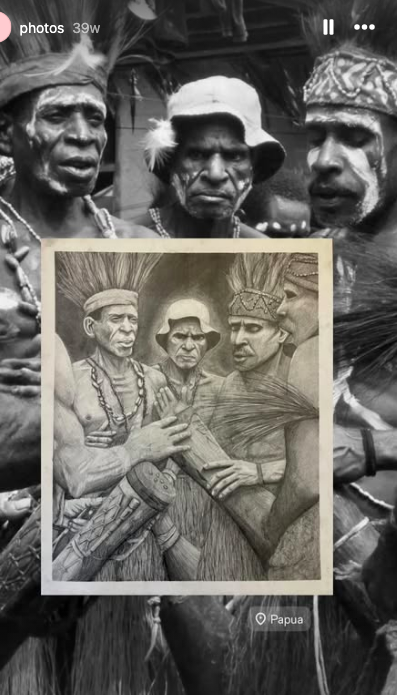
One of the highlights of my time in West Papua was the opportunity to spend a day with the Kamoro, learning their cultural traditions, including their drumming. My daughter, who was 8 at the time, captured a powerful photograph that she recreated for her AP art project last year: Kamoro men drumming, an image that became emblematic of the resilience and cultural survival of the Kamoro people. (See photo above)This moment connected deeply with Joanna Macy’s reflections on cultural healing and resistance. In Macy’s work, she encourages us to recognize grief as an expression of resilience, and I saw this in the Kamoro’s survival through their art, music, and language, despite the challenges they faced.

Through Kal Müller’s anthropological work with the Kamoro, which helped us navigate our visit, I was able to understand that Jared Diamond's ideas in Guns, Germs, and Steel — how resource extraction reshapes the course of Indigenous peoples’ lives — were not just theoretical. Müller’s research and Diamond's historical framework revealed the ongoing consequences of resource extraction, showing how the Kamoro's culture was not just being displaced physically but erased in the global economy. Müller’s efforts to help foreigners understand the Kamoro were crucial in preserving the people’s voice and sovereignty, much like Diamond's global perspective on colonization and resource extraction.

Müller’s ethnographic work provides a powerful lens through which to view the eco-grief discussed in the readings. He documents how the Kamoro’s cultural identity is deeply tied to their land and how the destruction of their ancestral environment by the Grasberg Mine has displaced them, both physically and psychologically. As Joanna Macy describes, grief is not just an emotional response to loss, but a recognition of deep connections to the land, people, and culture. The Kamoro's grief is therefore both environmental and cultural, reflecting eco-grief as described by Macy, and a clear manifestation of the colonial relationship between resource extraction and Indigenous displacement.

When I consider Aph Ko’s discussion of grief as a racialized and colonial experience, I see how the Kamoro’s sorrow goes beyond environmental loss. Their grief is tied to a historical pattern of exploitation — where colonialism and resource extraction have historically denied their humanity. The Kamoro people's grief, as well as their resilience, are part of the legacy of colonial systems that continue to affect Indigenous communities across the globe.

The devastation caused by the mine is well-documented, such as in The Guardian’s photographs of West Papua, showing the toxic waste and ecological destruction that continues to damage the land.

This destruction, combined with the historical trauma experienced by the Kamoro, creates a vicious cycle of grief and loss that is rooted in colonial violence. This collective eco-grief, as described by Joanna Macy, can only be fully understood when seen through the lens of colonialism and racial oppression, which is still ongoing in places like West Papua.

As I reflect on the eco-grief described in the readings and my experiences in West Papua, it is undeniable that the very copper and gold extracted from the Grasberg Mine are essential components of the technology that powers our daily lives. Copper, for example, is a core element of the smartphones, computers, electric cars, and renewable energy technologies we use every day. Gold, too, is integral in the electronics we rely on, including the devices in our pockets. These minerals, extracted at great human and ecological cost, fill a global demand that is essential to modern life — but this comes at the expense of communities like the Kamoro, who suffer displacement and loss of their ancestral lands.

This stark reality forces us to confront the uncomfortable truth that our everyday lives are sustained by the extraction of these resources, often from lands that belong to marginalized peoples. By recognizing this, we must ask ourselves: How do we change our behaviors, our consumption habits, and our global economic systems to reduce the harm caused by these resource extraction practices? The environmental and cultural damage inflicted on the Kamoro people can only begin to be addressed when we confront the systemic inequalities that perpetuate this cycle of extraction and exploitation. If we want to change the impact on the environment and on Indigenous communities, we must also change the way we live and the resources we consume.

Related Blog Posts:

Kamoro Tribe: Mware

Papuan Perspective

References:

Ko, Aph. Racism as Zoological Witchcraft: A Guide to Getting Out. North Atlantic Books, 2020.

Macy, Joanna. Active Hope: How to Face the Mess We're in without Going Crazy. New World Library, 2012.

Diamond, Jared. Guns, Germs, and Steel: The Fates of Human Societies. W.W. Norton & Company, 1997.

Müller, Kal. The Kamoro. 2022.

The Guardian. "West Papua: Verdant Heartlands Devastated by Mine Waste," November 2, 2016. [https://www.theguardian.com/global-development/gallery/2016/nov/02/west-papua-indonesia-verdant-heartlands-devastated-by-mine-waste-in-pictures](https://www.theguardian.com/global-development/gallery/2016/nov/02/west-papua-indonesia-verdant-heartlands-devastated-by-mine-waste-in-pictures

Tuesday, October 7, 2025

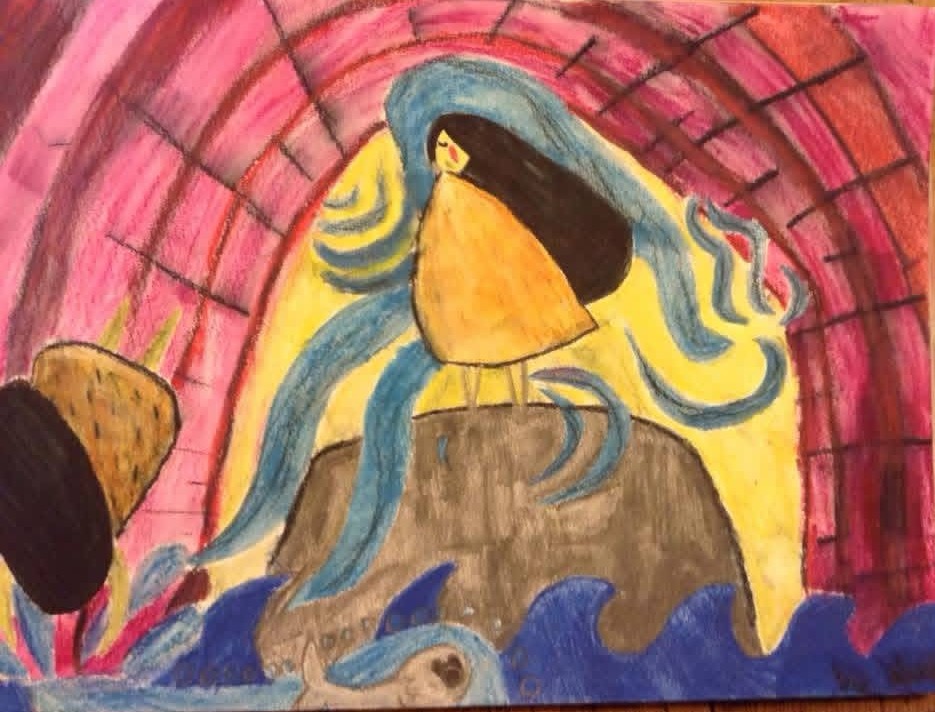
Song of the Sea by Kerry Marie Keating

In these nascent stages of my eco-chaplaincy study, I’ve come to understand that sacredness isn’t confined to temples or texts—it pulses through tide and time, in rituals passed down through generations, and in soul work of reconciliation. Watch Hill Beach is my sacred site. The sand is laced with my mother’s ashes. The wind carries our memories. In returning here, I am not just walking the shore—I am walking a spiritual path carved by waves, books, brokenness, and love. This is where I bring my sorrow. This is where I ask the sea—and the sacred within it—to help me find my way back.

The very name Watch Hill holds layers of meaning. Historically, it was a lookout point — first for the Narragansett and Niantic peoples, then for colonial settlers. Later, a lighthouse was built to help sailors navigate the waters safely. It has withstood hurricanes, erosion, and centuries of change. Its resilient beauty is breathtaking to me. Watch Hill is a place of vigilance, protection, and guidance. Similar to where my daughter is now- West Point-it is place created to keep people safe from harm. I never took Niamh's dad here, but I feel his presence in the wind. I see his shape in the clouds. I talk to him when I am here. I ask him to help me see a way back to Niamh. I ask him to help me keep her safe from harm- both foreign and domestic.

I came back to Watch Hill to find my way. Not to a place—but to a person. To my daughter. To myself. It’s where my daughter and I scattered my mother’s ashes. My daughter honored the grandmother she never knew. It’s where I have my happiest memories of love and peace throughout my life. Something about it brings out the best in us. Although she and I lived all over the world as I taught and traveled, I always brought her back here.

This beach was our return ritual. We have our traditions: a coffee and pastry from Sift, a long walk down the beach to watch the egrets and sandpipers by the bird sanctuary, a midday milkshake at St. Clair Annex, riding the waves all afternoon followed by a cheeseburger with bacon at the Olympia Tea House while we watch the sunset. These are simple, grounding rituals I shared with my own mother and passed down to my daughter. In our life marked by transience, those small repeated acts gave us a sense of place and continuity. My daughter and I were mostly on our own, and ritual was how we made ourselves feel like we belonged somewhere. Although I have endeavored to make our journey itself our home—this stretch of sand and sea has become a place for us to return and remember who we are.

Now my daughter and I are estranged. And my heart is lost. She is my compass point but I am struggling to find my route back to her. For many months now, my sole purpose each day is to find my way back to her heart. She is chuisle mo chroí—the pulse of my heart. My magnum opus. She is at West Point now in her first year, becoming someone braver and bolder. She carries both her trauma and her ambition as she learns how she can utilize the strength she has gained from both to one day lead with courage and candor. I come back to this beach—to ask for guidance and for glimmers of hope. To chant daimoku. To walk. To pray. To grieve. To breathe. To heal my heart. To return myself to the person she needed me to be.

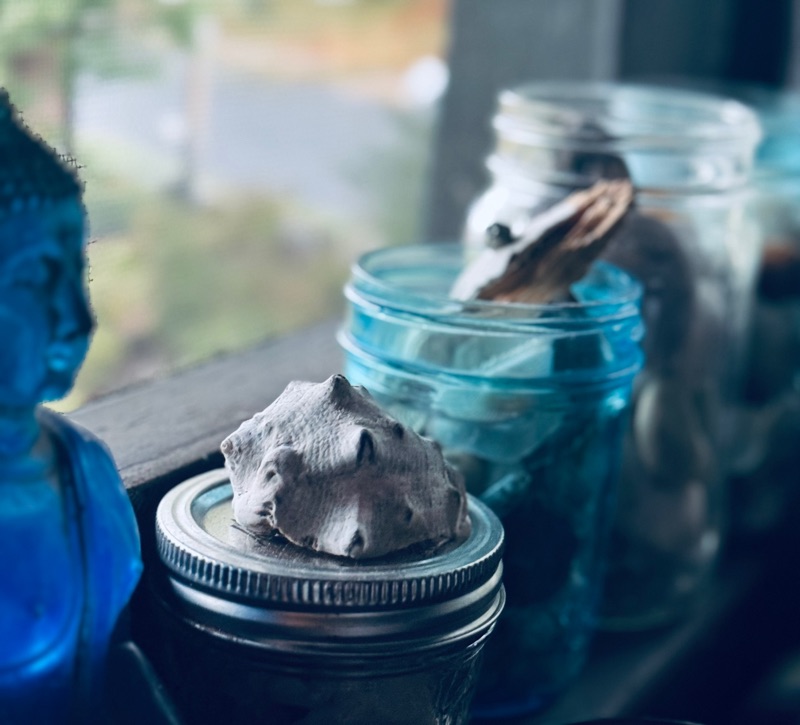
When I walk the shoreline now, I feel like I am many women at once: I am my mother’s daughter, and my daughter’s mother. I am 8. I run down the sand, chasing my mother’s petite form—so full of lightness, like a sandpiper scampers along the tide. I am 32. I hold my mother’s arm as she braves the waves she fears. I am 38. I imprint my daughter’s tiny foot in the sand. I am 47. I witness my daughter’s delight as she dives into the waves, playing like a seal in the seafoam—an Aries water baby in her element, no matter how cold the sea might be that day. I am 55. I walk alone. I am collecting seashells and sea glass with them both in my heart, placing them in jars—just like my mother did. Just like my daughter loves to do. I have those jars now. They sit on my porch. When I chant near them, I feel close to both of them at once—Anne-Marie and Niamh-Marie.

When my mother died ten years ago-she left behind a small trust that changed my daughter’s life — providing enrichment opportunities I could never have afforded as a single mom and a teacher: violin lessons, backcountry ski club, rugby camps and tours, a NOLS expedition in the Alaskan Talkeetnas, a cultural immersion trip to Peru’s Andes. These experiences helped my daughter imagine possibility. Something my mother–an Emily Dickenson fan–liked to dwell in. My mother — always the teacher — knew that experience and education opened doors and shaped lives. She did that for my daughter. The granddaughter she never knew. Today I sat by the sea and thanked her. She parented through literature. She gave me Gift from the Sea when I turned 21. Story was her compass. Books were her guideposts. And now I see some of the most important lessons were learned over time and through experience. The sea helps me see them as I walk by her side and listen to its song.

In April 2022, my daughter’s father—Colin—was struck by a car in Ireland, not far from his home. He lay in a coma for weeks before he died. My daughter turned fifteen during those suspended days. Before we could fly to Ireland to sit vigil, we came here—to Watch Hill. We sought solace by the ocean, where my mother’s soul is now part of the sand and sea. In the blustery New England spring, we sat together on the stones, stunned and silent. The cacophony of waves crashing on the rocks spoke for us while the ocean held what we could not carry. The sea eased the weight of our sadness. We sent our love and hope to Colin across the Atlantic—no hospitals, no borders, no time zones, no dysfunctional family histories—just open water between us and him. The sea became our conduit, our only act of faith in a moment of unbearable not-knowing. The sea bore witness to our sorrow.

Though Colin hadn’t been part of our daily lives, I nurtured their relationship for fifteen years. They were truly two peas in a pod. They found their connection in rugby. She will now honor him on the rugby pitch at West Point—playing the game he shared with her, carrying his spirit in every tackle, every pass, every try. His death shattered something fragile we had just begun to build. And in the aftermath, I turned all my focus toward what I imagined was my daughter’s grief as well as the practical work of our survival. I didn’t tend to my own pain as I should have, and that neglect became a wound between us. I know now I carried the weight of a lifetime of unresolved grief and abandonment—pain that seeped into everything and that my daughter absorbed. For this I am deeply sorry.

She was entering puberty. I was entering perimenopause. We were both raw, both unmoored, both aching and unsure of how to hold ourselves—let alone each other. Grief isolates and distorts. Ours festered until our relationship fractured under the weight of what we could not say. I was terrified she would endure the same turmoil I did after losing my father, yet I didn’t know how to help her because I had never learned to help myself. Instead, I succumbed to fear and control.

I come to the beach now—to heal, to ask for forgiveness, to hear myself think, and then -- to stop thinking. To find my way back to myself.

I am seeking what I call the sextant of sacred grief—a way to find true north when the heart has lost its bearings. A sextant is a maritime instrument used by sailors to locate their position by measuring the angle between celestial bodies and the horizon. But it is also a symbol: of orientation, of seeking, of connecting heaven and earth in the pursuit of direction. I seek connection to the heavens when I talk to my mother about the heartache unique to every mother. I seek Colin’s counsel, asking him to help me heal our daughter’s pain—hoping he can see what I cannot yet face. The sextant reminds me that healing and reconciliation are not maps; they are acts of navigation. It cannot promise a clear or easy route, but it can offer orientation. It says: Here is where you are. Now, where will you go?

I sit by the sea and send these words out into the world:

To my daughter, mo chroi: I know I failed you in ways I am only now beginning to understand. If I could go back, I would hold you tighter. Listen to hear and to understand. I would let you be angry. I would trust you more to learn from your mistakes. I would let you be–you. Princess Niamh of Tir Na Nog. Nuckachakanikachakanu with her Magic Freckle. I would let you learn in your own time and in your own way. If there’s ever a way forward, I will walk it with open hands and heart. I’ll wait at the shoreline. The kitten of the Mist waits with me. The sea sings our song.


My brother got a tattoo of a sextant on his back. It was his symbol of survival—of finding direction and navigating back from the brink of alcoholism. He too loves the sea and has found the sacred in it as a surfer and sailor. From what I hear now, his soul sextant has guided him to the happiest, healthiest time in his life. In my family, love and loss have always been tightly braided. The sextant on his back—the very symbol I now carry in my heart—feels like a message: that we’re all trying to find our way. Sometimes we help each other navigate the storm, only to drift apart again. I go to the sea now to ask the sacred to help me break this cycle. To help me find my way back—this time, to my daughter.

For me, the sextant is sacred. It is the symbol of the spiritual work I’m doing now—charting my way through grief, guilt, shame, regret, and longing. It is how I remember that though I feel lost—untethered and unmoored—I am not directionless.

My father gave me Jane Eyre on my sixteenth birthday. Decades later, after his death and my own estrangement from my daughter, I see it for what it was—a lesson in how love--to survive--must learn to forgive. My father loved more than literary maps. He loved route finding too. He planned road trips in his white VW Beetle, finding hikes and hidden beauty, sharing with us his reverence for nature. He taught me to plan a route that would become an adventure—full of possibility and wonder. He didn’t always ask, “What’s the fastest way?” but, “What’s the most beautiful one?” He taught me to think for myself, to make informed choices, and to always have an alternate route in mind. I hear both my parents’ voices now as I walk this beach, trying to find my way back to my daughter. Trying to stop the cycle of silence, shame, and separation. I feel the pain I caused both of them and I ask for their forgiveness.

Marine biologist Wallace J. Nichols coined the term Blue Mind to describe the calm, meditative state we enter when we are near water. The ocean slows the brain. Softens the ego. Invites awe. Opens the heart to truths we need to see. It helps us remember we are small—but not alone. It has saved me many times—and especially now. This is why I feel peace here—even as the tears that stream down my face blend with the salty sea air. It allows me sanctuary so that I am able to finally release generational sorrow. The power of the sea is not only to erode and wash away. Science tells us that sea air is full of negative ions, which elevate serotonin and lighten mood. But long before science confirmed it, we knew: the sea heals. It cleanses. It connects. The ocean is where I go to feel something larger than myself. It’s where I go to listen—to the waves, to my mother, to the ache in my heart, to the love that still lives beneath all the hurt. It’s where I go to remember that time is a tide, and love is never fully lost.

The rituals of this beach—the milkshakes, the dinners, the walks, the waves—were the last things I did with my mother before we became estranged over my pregnancy. They are also what I passed on to my daughter. I return to them now as prayer. When I walk this beach, I chant. I remember. I ask. I grieve. I breathe. I work to accept what has happened and my role in it, as well as to align with the future I still hope for with and for my daughter

I gather pieces of sea glass and place them in jars like my mother and daughter did. I sit with those jars on my porch, surrounded by all three of us—past, present, and hoped-for future. The shells are like chapters in the story Gift from the Sea that my mother gave to me when I turned 21. In that book, each shell symbolizes a distinct stage of life, reflecting Anne Morrow Lindbergh’s journey and relationships, with the shells themselves serving as metaphors for the impermanence and cyclical nature of existence. My mother gave me a theology of salt and silence, of tide and time. She showed me that healing is not linear, and that the sea—with its turning shells and vanishing footprints—teaches us how to love, how to let go, and how to return.

I know I cannot undo the harm. But I can hold it. I can heal. I can try to transform it into something that might one day lead back to the places we hold in our hearts for one another. I am my mother’s daughter, and my daughter’s mother. I walk the beach with both of them beside me. I carry their hearts in my heart as I walk. Through it all the sea sings its song. I walk to find the way back. The journey is my map. The sea watches and listens. The waves bear witness. They hear the song of hope in my soul and sing with me.

May the sea keep whispering to you, even when I can’t.

May you always know that you are my heart.

Mo chroí.